Transcendent Ideals
Plato's realm of perfect Forms as the ultimate reality beyond sensible particulars
Immanent Unity
Aristotle's hylomorphic view of form and matter as inseparable co-principles
Synthetic Reason
Kant's transcendental synthesis of empirical content and a priori forms
The Interplay of Content and Form
A Philosophical Analysis from Plato to Marx
Introduction
Philosophers from Plato to Marx have offered diverse perspectives on the interplay of content and form. This fundamental philosophical relationship has shaped our understanding of reality, knowledge, and artistic expression across centuries of intellectual inquiry.
Each philosopher in our survey—Plato, Aristotle, Kant, Hegel, and Marx—developed distinctive frameworks for understanding this relationship. Their theories range from Plato's transcendent Forms to Marx's materialist determination, encompassing approaches that view form as immanent, transcendental, dialectical, or socially constructed.
This analysis will explore how these philosophical giants conceptualized the dynamic between content and form, examining their implications for both aesthetics and epistemology. We will trace the evolution from Plato's idealist transcendence to Marx's materialist immanence, revealing how each philosopher's historical context and intellectual commitments shaped their understanding of this fundamental relationship.
1. Plato: Forms as Transcendent Paradigms

1.1 The Theory of Forms
Plato's Theory of Forms, a cornerstone of his philosophical system, posits a fundamental distinction between the transient, imperfect world of sensible particulars and the eternal, unchanging realm of ideal Forms [1], [2]. These Forms are understood as the ultimate reality, the true objects of knowledge, existing independently of the physical world and human perception.
The Forms are characterized by several key attributes: they are eternal, unchanging, indivisible, and non-sensible [3], [4]. They serve as the paradigms or perfect exemplars of their respective properties. For instance, the Form of Beauty is perfectly and unqualifiedly beautiful, surpassing any beautiful object in the sensible world.
1.2 Content as Imitation of Form
The relationship between the content of the sensible world (particular objects) and the Forms is primarily conceptualized through the notions of imitation (mimesis) and participation (methexis) [5], [6]. Sensible particulars are not the ultimate reality but are rather reflections or instantiations of the perfect, eternal Forms.
1.3 Epistemological Implications
Plato's distinction leads to a clear demarcation between knowledge (epistēmē) and opinion (doxa) [7], [8]. True knowledge, for Plato, is exclusively concerned with the Forms. The process of acquiring knowledge is often described as recollection (anamnesis), where the soul remembers its pre-incarnation encounter with the Forms.
1.4 Aesthetic Implications
Plato's theory profoundly shapes his aesthetic views, leading to a predominantly critical stance towards art [9]. Since the physical world is already an imitation of the perfect Forms, art becomes an "imitation of an imitation," or a copy of a copy, placing art at a third remove from true reality.
This ontological inferiority has significant epistemological and ethical implications. Plato argues that art fails to provide genuine knowledge or moral education because it deals with appearances rather than essences. In his ideal republic, he proposes strict censorship of art, allowing only those forms conducive to moral education.
2. Aristotle: Hylomorphism and Inseparability

2.1 Form and Matter as Co-Principles
Aristotle's metaphysics centers on the concept of substance (ousia), which he identifies as the primary category of being. Substance is a composite of two co-principles: matter (hyle) and form (eidos or morphe) [10]. This doctrine, known as hylomorphism, posits that every physical object is a unified whole resulting from the union of these two intrinsic principles.
Matter represents the potentiality or substrate of a thing, while form is the actuality or essence that gives a thing its specific nature, structure, and identity. Aristotle argues that these two principles are inseparable in concrete, existing substances [11].
2.2 Content as Potentiality Shaped by Form
In Aristotle's framework, matter (hyle) can be understood as the "content" that is given structure and definition by form. Matter, in itself, is characterized as potentiality—the capacity to receive form and become an actualized substance. The bronze is the matter for a statue; the sculptor imposes a specific form onto the bronze, actualizing its potential.
2.3 Epistemological Implications
Aristotle's hylomorphic understanding profoundly influences his epistemology. Unlike modern symbolic logic, Aristotle's logic is inherently "metaphysical" or content-sensitive [12]. The validity and strength of an argument depend not only on its formal structure but also on the metaphysical status of the terms involved—their content, specifically their essence or ousia.
2.4 Aesthetic Implications
Unlike Plato, Aristotle offers a more positive assessment of art by emphasizing the unity of form and content within the artwork itself [13], [14]. Art is not a simple copy of the sensible world but a creative process (techne) that involves the artist imposing a form onto matter to create a new, organized whole.
In his Poetics, Aristotle analyzes tragedy, identifying plot as the most important element, describing it as the "soul of tragedy" and the principle of its organization. The content is given shape and meaning by its plot structure, achieving a specific effect on the audience—the katharsis of emotions such as pity and fear.
3. Kant: Transcendental Idealism

3.1 Form as A Priori Structures
Kant's epistemology identifies "form" as not derived from experience but antecedent to it. These forms are a priori, meaning they are independent of all particular sensory impressions. Kant identifies two primary types: the forms of sensibility (space and time) and the forms of the understanding (categories) [15].
The categories—such as unity, plurality, substance, cause, and necessity—are the fundamental logical functions that the mind uses to synthesize the manifold of intuition into coherent objects and objective judgments. These forms are not inherent in objects themselves but are imposed by the cognitive apparatus of the subject.
3.2 Content as Sensory Matter
For Kant, "content" refers to the sensory matter (Materie) that is given to the mind through empirical intuition [16]. This sensory content is the raw, undetermined material that is subsequently organized and structured by the mind's a priori forms.
3.3 Synthesis in Cognition and Judgment
The core of Kant's epistemological project is to explain how synthetic a priori judgments are possible. This explanation rests on the synthesis of form and content in the act of judgment. Judgment is the process by which the understanding applies its pure concepts to the manifold of intuition, thereby unifying it into a coherent representation of an object.
3.4 Aesthetic Implications
Kant's Critique of Judgment introduces the distinction between "free beauty" (pulchritudo vaga) and "adherent beauty" (pulchritudo adhaerens) [17]. Free beauty is independent of any preconceived concept, based solely on the form of the object. Adherent beauty presupposes a concept of what the object ought to be.
In fine art, Kant elaborates on the interplay through "genius" and "taste": "Genius provides the matter for fine art, taste provides the form" [18]. Genius supplies the original, imaginative content (aesthetic ideas), while taste disciplines genius, ensuring the artwork is communicable and universally pleasing.
4. Hegel: Dialectical Development
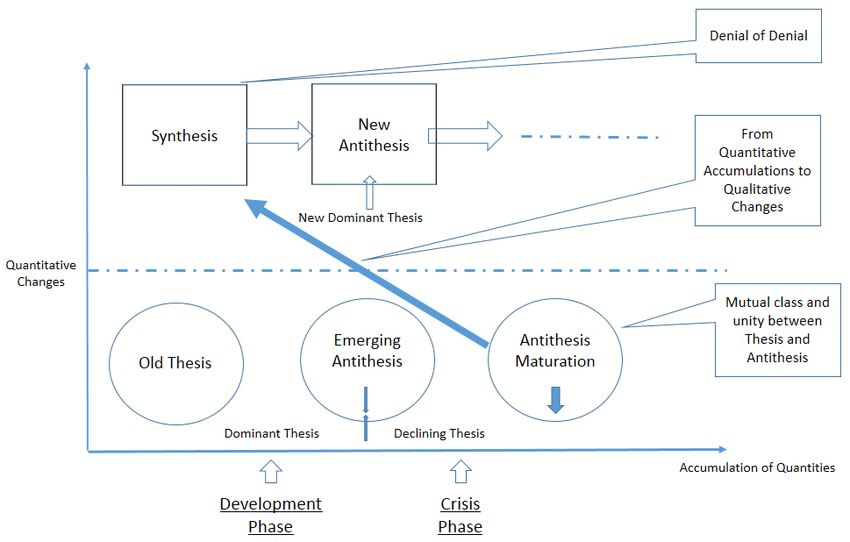
4.1 The Dialectical Method
Hegel's philosophy presents a radical departure by conceptualizing form as an immanent and necessary unfolding from the content itself [19]. The dialectical process involves three moments: understanding (thesis), dialectical negation (antithesis), and speculative unity (synthesis).
4.2 Content as Dynamic Ground
In Hegel's framework, content is not merely passive matter but the "ground" from which form is latent and necessarily emerges. The content itself is active and self-differentiating; it contains within itself the seeds of its own articulation and the impetus for its development into more concrete forms.
4.3 Identity of Content and Form in the Absolute Idea
Hegel's dialectical understanding culminates in the "Absolute Idea," where a complete identity of content and form is achieved. At this stage, the form of thought is no longer external to its content; rather, the form is the self-development and self-manifestation of the content itself [20].
4.4 Aesthetic Implications
Hegel's aesthetics focuses on the "Ideal" (das Ideal) as the perfect unity of profound spiritual content (Gehalt) with adequate sensuous form (Gestalt) [21], [22]. This unity develops historically through symbolic, classical, and romantic art forms.
Classical art achieves the pinnacle of the Ideal by realizing perfect harmony between content and form, as exemplified by ancient Greek sculpture. Romantic art marks a further development where spiritual content transcends the capacity of sensuous form to fully express it [23].
5. Marx: Materialist Dialectics
5.1 Critique of Idealism
Marx, heavily influenced by Hegel's dialectical method but inverting its idealist premises, argued that form emerges immanently from material and social content itself [24]. According to Marx, "the ideal is nothing else than the material world reflected by the human mind and translated into forms of thought" [25].
5.2 Content as Determining Form
In Marx's historical materialism, the "content"—encompassing material conditions, mode of production, and social relations—is the primary determinant of "form" in various societal aspects [26]. The economic base of society shapes the superstructure, which includes legal, political, religious, artistic, and philosophical forms.
Marx famously stated, "It is not the consciousness of men that determines their existence, but their social existence that determines their consciousness." The forms of thought, dominant ideas, and prevailing ideologies are largely determined by the material content of society.
5.3 Epistemological Implications
Marx's approach leads to the view that knowledge itself is shaped by social and historical forms. The forms of knowledge—concepts, theories, and logical frameworks—are not independent of social experience but are conditioned by material and historical circumstances.
5.4 Aesthetic Implications
Marxist aesthetics posits that art and its various forms are fundamentally shaped by and reflective of socio-economic structures and class relations [27]. The "content" of art derives from the artist's experience of social reality, while the "form" is conditioned by socio-economic factors and available technologies.
As Terry Eagleton notes, the relationship between form and content in art is complex and dialectical, akin to the relationship between base and superstructure. Georg Lukács argued that "the true bearers of ideology in art are forms" [28].
6. Comparative Perspectives and Contemporary Relevance
6.1 Contrasting Views
The philosophical journey from Plato to Marx reveals a rich tapestry of thought on the interplay of content and form. A central axis of contrast lies in the movement from Plato's emphasis on transcendent Forms to Marx's focus on immanent material and social conditions.
| Philosopher | Primary Locus of Form | Relationship to Content | Key Mechanism |
|---|---|---|---|
| Plato | Transcendent Realm of Forms | Content imitates Form | Mimesis, Methexis |
| Aristotle | Immanent in Substance | Form actualizes Matter | Entelechy, Four Causes |
| Kant | A Priori Structures of Mind | Form structures Content | Categories, Forms of Sensibility |
| Hegel | Immanent in Content (Idea/Spirit) | Form unfolds from Content | Dialectical Process |
| Marx | Immanent in Material/Social Content | Form determined by Content | Materialist Dialectics |
6.2 The Enduring Debate: Primacy of Form vs. Content
The historical analysis reveals an enduring philosophical debate concerning the primacy of form versus content. Plato's framework clearly prioritizes Form as the eternal source of reality. Aristotle gives priority to form as the actualizing principle. Kant's transcendental idealism gives a kind of priority to form as necessary conditions for experience.
Hegel's dialectic aims to overcome such one-sided prioritization through the identity of content and form in the Absolute Idea. Marx explicitly argues for the primacy of content (material conditions) in determining form, challenging idealist views that prioritize abstract forms.
Evolution of Form-Content Relationship
6.3 Contemporary Relevance
The debate between 97.
Simple Practice Steps:
Close your eyes and breathe naturally
Mentally say "breathe in" as you inhale
Mentally say "breathe out" as you exhale
Notice sensations in nostrils, throat, or belly
When mind wanders, gently return to breath
Mindfulness Meditation
Paying attention to the present moment without judgment. Observing thoughts, feelings, bodily sensations, and the surrounding environment as they are 89 104.
What to Observe:
• Thoughts as they arise
• Physical sensations
• Emotions without analysis
• Sounds and smells
Key Attitude:
• Non-judgmental awareness
• Curious observation
• Gentle acceptance
• Present-moment focus
Body Scan Meditation
Systematically bringing awareness to different parts of the body, from the toes to the top of the head, or vice versa. Tuning into physical sensations without judging them 90 96.
Body Scan Process:
Physical Focus:
• Notice points of contact
• Feel weight and pressure
• Observe temperature
• Detect tension or relaxation
Mental Approach:
• Move attention systematically
• Explore with curiosity
• Accept all sensations
• Release judgment
Loving-Kindness (Metta) Meditation
Focused on cultivating feelings of love, compassion, and goodwill towards oneself and others. Typically involves silently repeating phrases of well-wishing 96.
Traditional Sequence:
1
Yourself: "May I be happy, may I be healthy..."
2
Loved ones: "May you be safe, may you be peaceful..."
3
Neutral people: "May you be happy, may you be free..."
4
Difficult people: "May you be peaceful, may you be free..."
5
All beings: "May all beings everywhere be happy..."
Guided Meditations
An excellent resource for beginners, providing structured instruction and a focal point, helping individuals to connect with the practice and let go of self-judgment 89.
Benefits:
• Structured guidance
• Variety of techniques
• Reduced self-judgment
• Accessible for beginners
Where to Find:
• Meditation apps (Headspace, Calm)
• YouTube channels
• Podcasts
• Local meditation centers and form remains highly relevant in contemporary aesthetics and epistemology. In aesthetics, questions about the relationship between an artwork's subject matter and its style, structure, and medium are central to artistic creation and criticism.
In epistemology, the distinction resurfaces in discussions about the relationship between sensory data and conceptual frameworks. The insights of these philosophers continue to inform contemporary debates about artistic value, cognitive frameworks, and the social conditioning of knowledge.
Comments
Post a Comment
Thank you for your comment! We appreciate your thoughts. Please keep your comments respectful and relevant to the topic. Enjoy your time on our blog!